
In short
Some foot and ankle problems need more than a standard operation: surgery that has not worked, a fracture that has healed in the wrong position (malunion) or not healed at all (non-union), a significant deformity, or arthritis affecting several joints. These need a careful assessment to find the cause, detailed scans to plan treatment, and an honest discussion of what surgery can and cannot achieve. Non-operative options such as bracing and custom insoles are always considered. Surgery may involve realigning bones, fusing joints, revising previous fixation or bone grafting, sometimes in stages.
What counts as complex foot and ankle surgery?
There is no single definition, but these problems have in common that the anatomy is no longer normal, often because of previous injury or surgery, and that more than one problem needs solving at the same time. They include:
- Revision of failed surgery, such as a bunion that has come back, a fusion that has not joined, or an ankle replacement that has become painful or loose
- Deformity correction of a flat foot, high-arched (cavovarus) foot or an ankle that has tilted
- Malunion and non-union after fractures of the ankle, heel, talus or midfoot
- Complex arthritis affecting several joints, often with deformity, or arthritis after a previous fracture
What are the symptoms?
- Persistent pain after an injury or operation, beyond the expected recovery time
- A foot or ankle that looks or feels out of line, or shoes that wear unevenly
- Instability or difficulty walking on uneven ground
- Swelling, stiffness or clicking around metalwork or a previous fracture
- Pressure areas, calluses or ulcers from abnormal loading
Assessment
Assessment starts with a full history of the original problem and every treatment since, including operation notes and previous scans where available. The aim is to understand why the problem has happened, not only what it looks like now.
- Examination of alignment standing and walking, the skin and previous scars, circulation, nerves and tendon function
- Weight-bearing X-rays of the foot and ankle, and sometimes of the whole leg
- CT scan to see bone healing, the joint surfaces and the three-dimensional deformity
- SPECT-CT, which combines a bone scan with CT, to show which joints or implants are causing pain
- MRI for tendons, cartilage and bone blood supply
- Diagnostic injections of local anaesthetic, to confirm which joint is painful
- Blood tests to look for infection and for factors that slow bone healing, such as low vitamin D or poorly controlled diabetes
Treatment without surgery
- Custom insoles or orthoses to support and offload the foot
- Bracing, including ankle-foot orthoses for deformity or instability
- Footwear changes, such as rocker-soled or extra-depth shoes
- Physiotherapy to maintain strength and walking
- Image-guided injections for painful joints
- Optimising health before any surgery: stopping smoking, diabetes control and vitamin D, all of which affect bone healing
Surgery
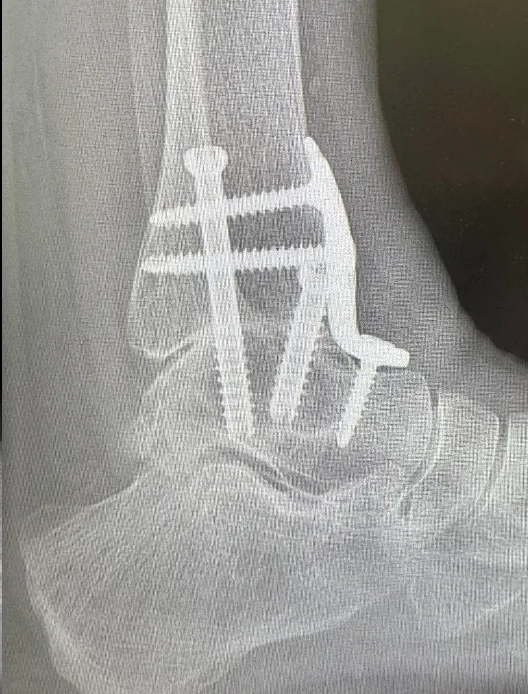
- Osteotomy. Cutting and realigning a bone to correct a malunion or deformity, for example above the ankle or through the heel.
- Joint fusion (arthrodesis) of the ankle, hindfoot or midfoot, often combined with correction of alignment. See ankle fusion, hindfoot fusion and midfoot fusion.
- Revision fixation and bone grafting for non-union, sometimes with removal of the original metalwork.
- Tendon transfers and ligament reconstruction to rebalance the foot, as in flat foot reconstruction.
- Revision of an ankle replacement, or conversion of a failed replacement to a fusion.
- Staged surgery, where treatment is split into more than one operation, for example to treat infection or soft tissues first.
Recovery after complex surgery is usually longer than after a first operation, with a period of protected or no weight-bearing. The expected recovery, risks and realistic goals are discussed in detail before deciding on surgery.
Common questions
Can foot or ankle surgery be redone if it has not worked?
Often, yes. The first step is to find out why it has not worked, for example a bone that has not healed, alignment that is not right, a new problem in a neighbouring joint, or infection. Revision surgery is then planned around that cause. Sometimes the right option is not more surgery, and that is discussed too.
Why has my fracture not healed?
Bone healing can be slowed by movement at the fracture, poor blood supply, infection, smoking, diabetes, low vitamin D and some medicines. A CT scan shows whether the bone has healed, and blood tests look for infection and healing factors before planning treatment.
Is there anything I can do before surgery?
Yes. Stopping smoking, good diabetes control, correcting low vitamin D and keeping as active as you comfortably can all help bone and wound healing. These are discussed at your consultation.
Will I need more than one operation?
Some complex problems are treated in one operation; others are safer in stages, for example treating infection or the soft tissues first. Your plan is explained before you decide.
Can I get a second opinion on surgery I have already been offered?
Yes. A second opinion is booked as a new consultation. Bring any previous scans, operation notes and letters if you have them.
Talk it through with a specialist
Consultations at Spire Liverpool, Salford and the Isle of Man. New patients £250.

Consultant Foot and Ankle Surgeon, MB BCh, PhD, FRCS (Tr&Orth), FRCS (Glasg), SFHEA, FFSTEd. GMC 6074953. Hunterian Professor, Royal College of Surgeons of England.
Page last reviewed 24 November 2026. This information is general and does not replace an assessment.
Prof Mason's published research on this topic
Peer-reviewed papers by Prof Mason and his colleagues. Links open the paper or its PubMed record.
- Fischer B, Mason LW. Reconstruction of severe ankle and pilon fracture malunions. Foot and Ankle Clinics, 2020.
- Mason LW, Wyatt J, Weishman H, Butcher C, Molloy AP. Single-photon emission computed tomography in painful total ankle replacements. Foot & Ankle International, 2015.
- Grant M, Molloy A, Mason LW. The use of percutaneous screw fixation without fracture site preparation in the treatment of 5th metatarsal base non-union. Journal of Foot and Ankle Surgery, 2020.