
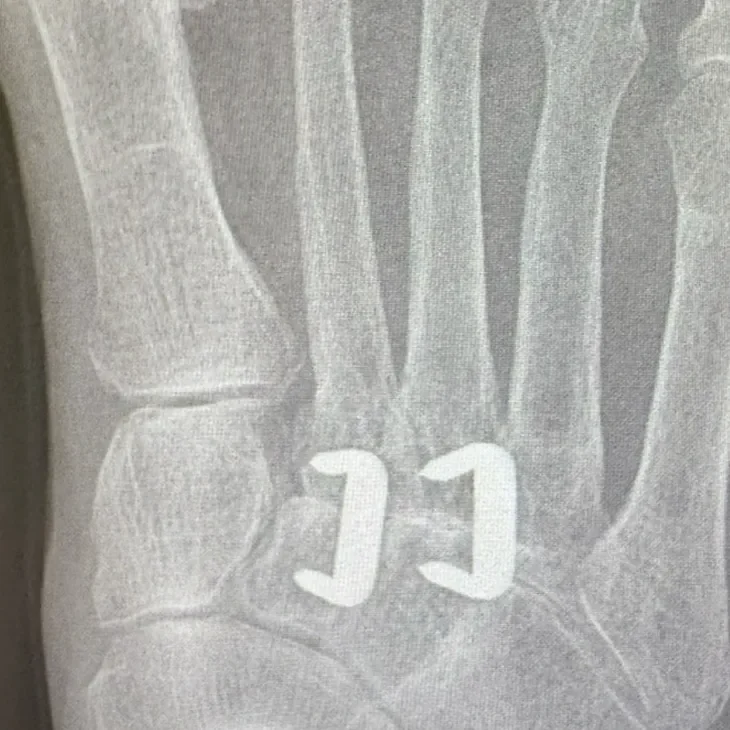
In short
Midfoot fusion treats painful arthritis, instability or deformity of the midfoot when other treatments have failed. The worn cartilage is removed, the bones are realigned and held with screws or plates until they grow together, eliminating painful movement. You are usually non-weight-bearing in a cast or boot at first, an X-ray at 6 to 12 weeks checks the fusion before you progress to full weight-bearing, and most patients return to daily activities with improved comfort.
- Anaesthetic
- General or regional anaesthetic
- Hospital stay
- Usually a day case
- Walking afterwards
- Non-weight-bearing with crutches at first, in a cast or boot
- Full recovery
- 3 to 6 months and beyond
Why is surgery sometimes needed?
Midfoot fusion surgery is used to treat painful arthritis, instability or deformity of the midfoot when other treatments have failed. The midfoot includes the bones that help support the arch of the foot. When these joints are damaged, they can cause pain, stiffness and difficulty walking. Fusion joins the painful bones together, eliminating movement at those joints to reduce pain and restore a stable, pain-free foot.
What does the operation involve?
- The surgery is usually performed as a day case under general or regional anaesthetic
- The affected midfoot joint surfaces are carefully exposed and the cartilage is removed
- The bones are realigned into a natural position for walking
- Metal screws, plates or other devices hold the bones in place while they fuse (grow together)
- Over time, the bones heal solidly to eliminate painful motion
The exact joints fused depend on where the arthritis or instability is located (for example, the naviculocuneiform or tarsometatarsal joints).
Recovery: what to expect
0 to 2 weeks
- Your foot will be in a cast or rigid boot to protect the fusion
- Non-weight-bearing with crutches is commonly advised initially
- Elevation is important to reduce swelling
- Stitches are usually removed at 10 to 14 days
2 to 6 weeks
- Continue in a cast or boot as advised
- Gentle movement of the toes and non-weight-bearing or heel weight-bearing exercises are encouraged
6 to 12 weeks
- An X-ray will be performed to check on fusion progress
- Transition to protected weight-bearing (partial, then full) in a boot depending on fusion progress
- Physiotherapy usually starts to maintain strength above the ankle and prevent stiffness
3 to 6 months and beyond
- Most patients progress to full weight-bearing without a boot as the fusion consolidates
- Comfortable, supportive footwear is recommended
- Walking distances and daily activities increase gradually
- Some swelling may persist, especially after prolonged standing or activity
Recovery varies with the exact procedure and with each person. You will get a plan specific to your operation.
Expected outcomes
Before surgery
- Pain in the midfoot with walking or weight-bearing
- Difficulty wearing regular shoes
- Swelling or stiffness across the arch
- Reduced activity levels due to discomfort
After surgery
- Significant reduction or elimination of pain
- Improved midfoot stability and alignment
- Better walking comfort
- Ability to wear supportive footwear comfortably
- Durable long-term outcome in most patients
Most patients achieve stable bone fusion and lasting pain relief. Adjacent joints can adapt well, though a small percentage may experience increased stress in the long term. Supportive shoes and gradual activity progression improve outcomes.
Consent information
Read the consent form before your operation so you know what you are agreeing to. Bring any questions to your pre-operative appointment.
- Consent form: midfoot fusion (Word document)
Considering this operation?
Talk it through with Prof Mason. New consultation £250.

Consultant Foot and Ankle Surgeon, MB BCh, PhD, FRCS (Tr&Orth), FRCS (Glasg), SFHEA, FFSTEd. GMC 6074953.
Prof Mason's published research on this topic
Peer-reviewed papers by Prof Mason and his colleagues. Links open the paper or its PubMed record.
- Ankers T, Singh A, Mason L, Sirikonda S. Arthrodesis of the second and third tarsometatarsal joints: comparison of clinical results using combined or individual plating techniques. Journal of Foot and Ankle Surgery (Asia-Pacific), 2023.
- Mason LW, Tanaka H. The tarsometatarsal joint and its association with hallux valgus. Bone & Joint Research, 2012.