
In short
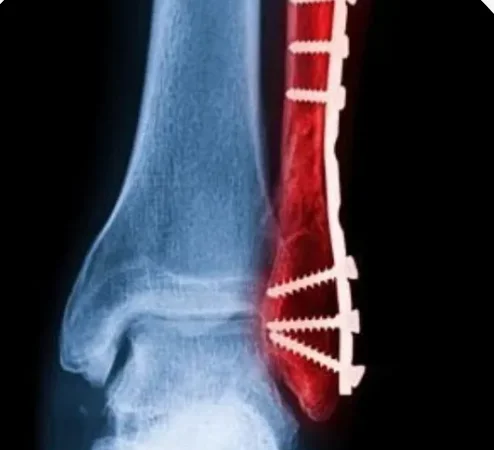
Screws, plates or staples used to repair fractures, correct deformity or fuse joints usually stay in place without problems, but a small proportion cause discomfort, irritation or shoe rubbing. Once healing is complete they can be removed, usually as a day case through the original incision. You can normally walk in a stiff-soled shoe, desk work is often possible within 1 to 2 weeks and most people resume full activity by 6 to 12 weeks.
- Anaesthetic
- General or regional anaesthetic
- Hospital stay
- Usually a day case
- Walking afterwards
- Usually walking in a stiff-soled shoe
- Full recovery
- 6 to 12 weeks
Why is removal sometimes needed?
Screws, plates, staples or other fixation devices are sometimes used in foot and ankle surgery to repair fractures, correct deformity or fuse joints. Most metalwork remains in place long term without causing problems, but a small proportion of patients may experience discomfort, irritation or shoe rubbing. In such cases, metalwork removal can improve comfort once healing is complete.
What does the operation involve?
- Removal is usually performed as a day case under general or regional anaesthetic
- The original surgical incision (or a nearby incision) is reopened
- Screws, plates, wires or staples are carefully removed
- The bone and soft tissues are inspected for irritation or scar tissue
- The wound is closed with stitches and a dressing applied
- If bone graft or fusion was involved originally, imaging is used beforehand to confirm full healing
In some cases, only part of the hardware needs to be removed (for example, prominent screws).
Removal of painful metalwork is usually a straightforward procedure designed to relieve discomfort once bones are fully healed after previous foot or ankle surgery. By removing prominent or irritating hardware, the operation improves local comfort, footwear tolerance and activity levels. Recovery is typically quicker than the original surgery, and outcomes are generally very good when symptoms are clearly related to the metalwork.
Recovery: what to expect
0 to 2 weeks
- Dressings protect the incision site
- Weight-bearing is usually allowed in a stiff-soled shoe unless otherwise specified
- Elevation helps reduce swelling
- Stitches removed at 10 to 14 days
2 to 6 weeks
- Swelling and scar sensitivity improve
- Transition to normal footwear as comfort allows
- Return to desk work is often within 1 to 2 weeks; manual roles may take longer
6 to 12 weeks
- Continued pain reduction and tissue settling
- Most patients resume full activity
Recovery varies with the exact procedure and with each person. You will get a plan specific to your operation.
Expected outcomes
Before surgery
- Pain over screws, plates or staples
- Shoe rubbing or pressure intolerance
- Local swelling or tenderness
- Limitation with footwear or activity
After surgery
- Reduced local pain and pressure
- Improved footwear comfort
- Less irritation during activity
- Faster recovery than the original surgery
Once tissues settle, most patients have lasting relief. If discomfort was due to scarring or nerve sensitivity, additional improvement may occur gradually. It is important to ensure the original bone surgery is healed before removal.
Consent information
Read the consent form before your operation so you know what you are agreeing to. Bring any questions to your pre-operative appointment.
- Consent form: removal of metalwork (Word document)
Considering this operation?
Talk it through with Prof Mason. New consultation £250.

Consultant Foot and Ankle Surgeon, MB BCh, PhD, FRCS (Tr&Orth), FRCS (Glasg), SFHEA, FFSTEd. GMC 6074953.