
In short
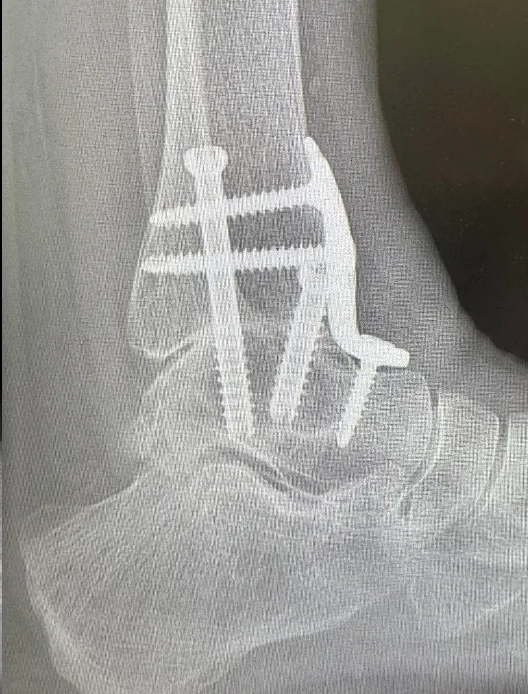
Ankle fusion is a well-established treatment for severe ankle arthritis. The worn cartilage is removed, the foot is set in the best position for walking and the bones are fixed with screws or plates until they heal into one solid unit, removing the painful movement. It can be done open, arthroscopically (keyhole) or through a mini-open approach. You are usually non-weight-bearing in a cast or boot for the first 4 weeks, X-rays at 6 to 12 weeks check the fusion, and recovery is longer than for many other foot operations.
- Anaesthetic
- General or regional anaesthetic
- Hospital stay
- Day case or short inpatient stay
- Walking afterwards
- Non-weight-bearing, usually for the first 4 weeks
- Full recovery
- 3 to 6 months and beyond
Why is surgery sometimes needed?
Ankle fusion surgery is a well-established treatment for severe ankle arthritis that causes persistent pain, stiffness and difficulty walking. When the joint surfaces are badly worn, movement becomes painful and limiting. Ankle fusion permanently joins the bones of the ankle together, removing the painful movement and allowing patients to walk more comfortably.
What does the operation involve?
- The procedure is usually performed as a day case or short inpatient stay under general or regional anaesthetic
- The damaged cartilage is removed from the ankle joint surfaces
- The foot is positioned in an optimal alignment for standing and walking
- The bones are fused together using screws, plates or a combination of fixation devices
- Over time, the bones heal together to form one solid unit, eliminating painful motion
Ankle fusion may be performed using open, arthroscopic (keyhole) or mini-open techniques depending on the condition of the joint and surrounding tissues.
Recovery: what to expect
0 to 2 weeks
- Your ankle will be protected in a cast or boot
- The leg should be kept elevated regularly to reduce swelling
- Non-weight-bearing is common initially, usually for the first 4 weeks
- Stitches are removed at around 10 to 14 days
2 to 6 weeks
- Continued protection in a cast or boot
- Gradual progression toward partial weight-bearing may begin if healing allows
- Swelling and stiffness are expected
6 to 12 weeks
- X-rays are taken to assess fusion progress
- Transition to increased weight-bearing as advised
- Physiotherapy may begin to strengthen surrounding joints and improve gait
3 to 6 months and beyond
- Most patients progress to full weight-bearing in normal shoes
- Walking comfort improves steadily as the fusion consolidates
- Return to low-impact activities such as walking, cycling and golf
- Final recovery and strength gains occur gradually
Recovery varies with the exact procedure and with each person. You will get a plan specific to your operation.
Expected outcomes
Before surgery
- Severe ankle pain with walking or standing
- Stiffness and loss of confidence on uneven ground
- Limited mobility and activity tolerance
- Poor response to non-surgical treatment
After surgery
- Significant reduction or elimination of pain
- Improved stability and walking comfort
- Ability to return to daily activities
- Strong, stable ankle with long-lasting results
Fusion is permanent once healed and most patients walk well without pain. Some stiffness is expected but is usually well tolerated. Supportive footwear helps protect the surrounding joints. Recovery following ankle fusion is longer than many other foot procedures, and patience during healing is important.
Consent information
Read the consent form before your operation so you know what you are agreeing to. Bring any questions to your pre-operative appointment.
- Consent form: ankle fusion (Word document)
Common questions
What's the difference between ankle fusion and ankle replacement?
Both treat severe ankle arthritis. Fusion joins the ankle bones so the painful joint no longer moves; it is permanent and durable once healed, and most people walk well, with some stiffness that is usually well tolerated. Replacement swaps the worn joint surfaces for an artificial joint, keeping some ankle movement, but the implant can wear or loosen over time and may need further surgery. Published comparisons show both give good pain relief. Prof Mason’s information sheets summarise the published data: comparison of ankle fusion and replacement (Word) and ankle fusion vs replacement summary (PDF). He will talk through which suits your ankle, alignment, activity level and health.
Considering this operation?
Talk it through with Prof Mason. New consultation £250.

Consultant Foot and Ankle Surgeon, MB BCh, PhD, FRCS (Tr&Orth), FRCS (Glasg), SFHEA, FFSTEd. GMC 6074953.
Prof Mason's published research on this topic
Peer-reviewed papers by Prof Mason and his colleagues. Links open the paper or its PubMed record.
- Feroz J, Makwana N, Mason L, Halliwell P, Rushton A. Accuracy and quality of the British Orthopaedic Foot and Ankle Society (BOFAS) Registry: ankle arthrodesis. Foot and Ankle Surgery, 2021.
- Mason LW, Wyatt J, Weishman H, Butcher C, Molloy AP. Single-photon emission computed tomography in painful total ankle replacements. Foot & Ankle International, 2015.
- Fischer B, Mason LW. Reconstruction of severe ankle and pilon fracture malunions. Foot and Ankle Clinics, 2020.