
In short
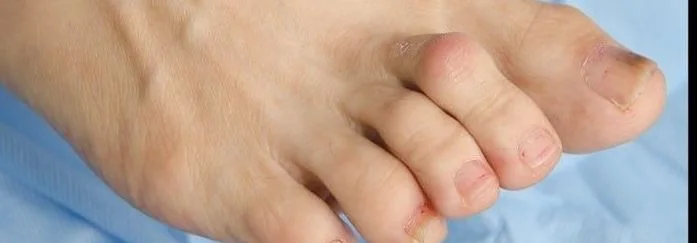
Lesser toe correction surgery straightens the second to fifth toes when hammer, claw, mallet or curly toes cause pain, rubbing, corns or difficulty walking. Depending on the deformity it may involve tendon releases or lengthening, joint capsule release, small bone cuts and temporary wires or screws. Temporary wires are removed in clinic at 4 to 6 weeks, toe taping is usually used for up to 12 weeks, and swelling can take over 6 months to settle.
- Anaesthetic
- Local, regional or general anaesthetic
- Hospital stay
- Usually a day case
- Walking afterwards
- Heel or partial weight-bearing in a post-op shoe or sandal
- Full recovery
- Swelling can take over 6 months to settle
Why is surgery sometimes needed?
Lesser toe correction surgery treats deformities of the second, third, fourth or fifth toes, such as hammer toes, claw toes, mallet toes and curly toes. These deformities can cause pain, rubbing in shoes, corns or difficulty walking. When non-surgical measures fail to relieve symptoms, surgical correction can straighten the toe, reduce pressure and improve comfort.
What does the operation involve?
The procedure is usually performed as a day case under local, regional or general anaesthetic. Small incisions are made over the affected toes. Depending on the deformity, surgery may involve:
- Tendon releases or lengthening
- Joint capsule release
- Small bone cuts (osteotomies)
- Temporary fixation with wires or screws
The aim is to realign the toe so it no longer rubs or causes pain. Once the correction is complete, wounds are closed with stitches and a dressing applied. Temporary wires may be used, which are removed in clinic between 4 and 6 weeks.
Prof Mason will explain the specific technique planned based on your toe shape and symptoms. Recovery time varies depending on the number of toes corrected and the specific procedures performed.
Recovery: what to expect
0 to 2 weeks
- Your toes will be bandaged or splinted in the corrected position
- You may be allowed heel or partial weight-bearing in a post-op shoe or sandal
- Elevation helps reduce swelling
- Stitches are usually removed at 10 to 14 days
2 to 6 weeks
- Continue to wear protective footwear as advised
- If temporary wires are used, these will be removed between 4 and 6 weeks
- Gentle toe movement exercises can begin as comfort allows
- Swelling and stiffness are common in early recovery
6 to 12 weeks
- Most people return to comfortable shoes with a wide toe box
- Walking and light activity increase gradually
- Toe taping is usually used for up to 12 weeks to maintain toe position
- Sensitivity around the toes may persist but improves over time
3 to 6 months and beyond
- Final improvement in comfort and toe alignment evolves
- Shoes fit more comfortably and pressure points reduce
- Return to higher-impact activities may be considered depending on progress
- Swelling can take over 6 months to recede
Recovery varies with the exact procedure and with each person. You will get a plan specific to your operation.
Expected outcomes
Before surgery
- Pain and pressure in toe deformities
- Difficulty with footwear
- Calluses, corns or rubbing
- Reduced walking comfort
After surgery
- Straighter toes and reduced deformity
- Less pain and pressure in shoes
- Greater comfort when walking
- Improved ability to wear a wider range of footwear
Most patients report lasting improvement in pain and toe alignment. Some swelling or stiffness can persist for several months. Maintaining flexible, roomy footwear supports long-term comfort. If fusions are used, the toes will remain stiff.
Consent information
Read the consent form before your operation so you know what you are agreeing to. Bring any questions to your pre-operative appointment.
- Consent form: lesser toe correction (Word document)
- Consent form: hallux valgus and lesser toe correction (Word document)
- Consent form: rheumatoid forefoot arthroplasty (Word document)
Considering this operation?
Talk it through with Prof Mason. New consultation £250.

Consultant Foot and Ankle Surgeon, MB BCh, PhD, FRCS (Tr&Orth), FRCS (Glasg), SFHEA, FFSTEd. GMC 6074953.
Prof Mason's published research on this topic
Peer-reviewed papers by Prof Mason and his colleagues. Links open the paper or its PubMed record.
- Mason LW, Jayatilaka MLT, Fisher A, Fisher L, Swanton E, Molloy A. Anatomy of the lateral plantar ligaments of the transverse metatarsal arch. Foot & Ankle International, 2019.
- Dave M, Mason LW, Hariharan K. Forefoot deformity in rheumatoid arthritis: a comparison of shod and non-shod populations. Foot & Ankle Specialist, 2015.