
In short
A cheilectomy treats hallux rigidus by removing the bone spurs on top of the big toe joint and cleaning the joint, so the toe can bend more easily with less pain. No joint is fused and movement is preserved. It is a day-case operation, you walk straight away in a post-operative shoe, desk work commonly resumes within 1 to 3 weeks, and recovery is typically quicker than fusion surgery.
- Anaesthetic
- General or regional anaesthetic
- Hospital stay
- Day case
- Walking afterwards
- Walking straight away in a stiff-soled post-op shoe
- Full recovery
- 3 to 6 months
Why is surgery sometimes needed?
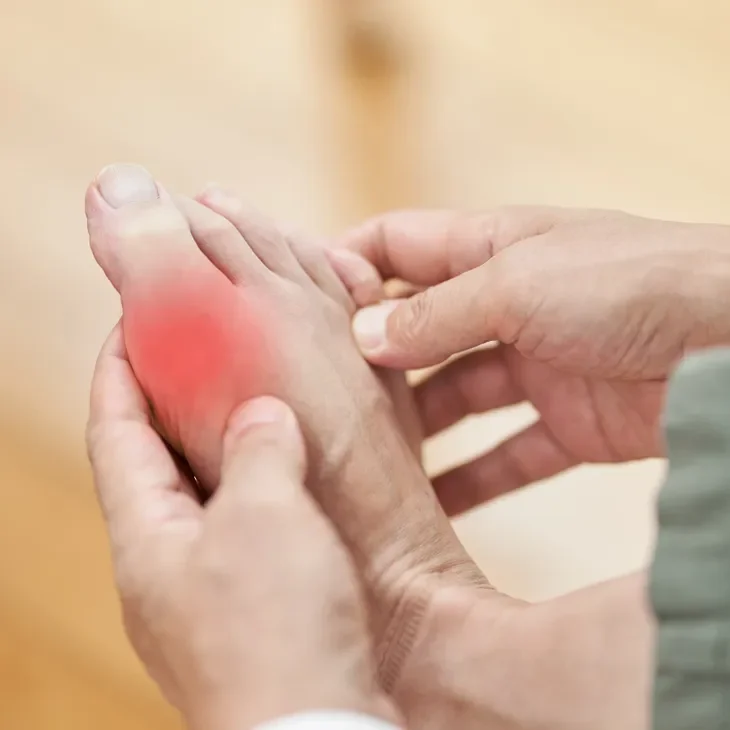
A cheilectomy is an operation used to treat hallux rigidus, a condition where arthritis causes pain and stiffness in the big toe joint. As bone spurs form around the joint, bending the toe becomes difficult, especially during push-off when walking. By removing these spurs, cheilectomy aims to improve movement, reduce pain and delay or avoid the need for joint fusion in the future.
What does the operation involve?
- Performed as a day case under general or regional anaesthetic
- A small incision is made over the big toe joint
- Bony spurs on the top of the joint are removed, and the joint is cleaned
- Sometimes additional small debridement or cartilage smoothing is performed
- No joints are fused, and movement is preserved
Cheilectomy is best suited for mild to moderate arthritis where joint space is still present.
What to expect on the day
- Usually home the same day
- Foot is bandaged
- You may walk using a post-operative shoe
- Pain is usually manageable with simple painkillers
- Elevation is important for swelling reduction
Recovery is typically quicker than fusion surgery because the joint is preserved.
Recovery: what to expect
0 to 2 weeks
- Dressings applied to protect the wound
- Weight-bearing in a stiff-soled post-op shoe is often allowed immediately
- Elevation reduces swelling; keep dressings dry
- Stitches removed at 10 to 14 days
2 to 6 weeks
- Swelling gradually settles
- Begin range-of-motion exercises to maintain flexibility
- Transition into wide or cushioned footwear as tolerated
- Return to desk work commonly within 1 to 3 weeks
6 to 12 weeks
- Most daily activities more comfortable
- Further improvement in movement and pain
- Start low-impact exercise such as cycling or swimming
3 to 6 months and beyond
- Continued increase in comfort and mobility
- Swelling may persist at the end of the day initially, gradually improving
- Higher-impact activities may resume when comfortable
Recovery varies with the exact procedure and with each person. You will get a plan specific to your operation.
Expected outcomes
Before surgery
- Pain when walking or bending the toe
- Limited movement and stiffness
- Difficulty with footwear, exercise and push-off
- Reduced daily mobility
After surgery
- Improved movement in the big toe joint
- Reduced pain during walking and push-off
- Better tolerance in everyday footwear
- Maintained joint motion
- May delay or prevent the need for fusion
Many patients achieve lasting symptom improvement. Arthritis may continue to progress over time in some cases, and maintaining mobility with exercises helps long-term function. If arthritis becomes severe later, fusion remains an option.
Consent information
Read the consent form before your operation so you know what you are agreeing to. Bring any questions to your pre-operative appointment.
- Consent form: 1st MTPJ cheilectomy (Word document)
Considering this operation?
Talk it through with Prof Mason. New consultation £250.

Consultant Foot and Ankle Surgeon, MB BCh, PhD, FRCS (Tr&Orth), FRCS (Glasg), SFHEA, FFSTEd. GMC 6074953.
Prof Mason's published research on this topic
Peer-reviewed papers by Prof Mason and his colleagues. Links open the paper or its PubMed record.
- Jadhakhan F, Makwana N, Mason L, Halliwell P, Rushton A. Clinical outcomes of first metatarsophalangeal joint arthrodesis using the BOFAS Registry: a prospective cohort study. Journal of Foot and Ankle Research, 2025.
- Weigelt L, Redfern J, Heyes G, Butcher C, Molloy A, Mason L. Risk factors for non-union after first metatarsophalangeal joint arthrodesis with a dorsal locking plate and compression screw construct: correction of hallux valgus is key. Journal of Foot and Ankle Surgery, 2021.
- Chapman J, Dalal N, Molloy A, Jenkinson H, Singh A, Sirikonda S, Mason L. Does a 1st metatarsophalangeal fusion in a patient with pes planus improve the pes planus deformity? A retrospective case series. Foot & Ankle International (accepted for publication).