In short
Big toe fusion surgery is a highly effective treatment for advanced arthritis of the big toe (hallux rigidus) and painful deformity that has not improved with non-surgical care. The damaged cartilage is removed and the bones are joined (fused) in a natural position with screws and/or a small plate. You can usually heel weight-bear straight away, an X-ray at 6 to 12 weeks checks the fusion, and swelling takes 3 to 6 months to settle. Once healed, the joint is pain-free.
- Anaesthetic
- General or regional anaesthetic
- Hospital stay
- Usually a day case
- Walking afterwards
- Heel weight-bearing straight away in a post-op shoe or boot
- Full recovery
- 3 to 6 months for swelling to settle
Why is surgery sometimes needed?
Big toe fusion surgery is a highly effective treatment for advanced arthritis of the big toe (hallux rigidus) and painful deformity that has not improved with non-surgical care. By joining (fusing) the bones of the joint together in a corrected position, pain is reduced and walking comfort improves, allowing patients to return to everyday activities with confidence.
What does the operation involve?
- The procedure is typically performed as a day case under general or regional anaesthetic
- The damaged cartilage is removed from both sides of the joint
- The toe is positioned in a natural alignment for standing and walking
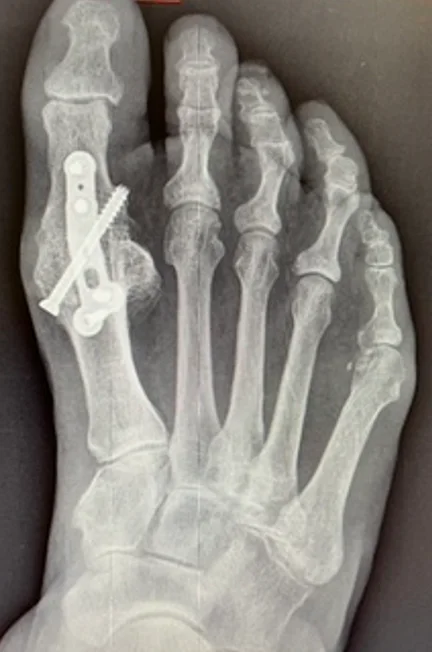
- The bones are then fused together using screws and/or a small plate to hold the joint while it heals
- Over time, the bones grow together, permanently removing movement at the joint to prevent pain
Fusion does not usually limit activity, and most patients walk better once the painful motion is gone.
Rheumatoid forefoot surgery
For people with rheumatoid arthritis affecting the whole forefoot, big toe fusion is often combined with surgery to the smaller toe joints (lesser toe resection arthroplasty) to remove painful pressure under the ball of the foot. A separate consent form for this combined operation is provided below.
Recovery: what to expect
0 to 2 weeks
- Foot is bandaged and protected in a post-op shoe or boot
- You may heel weight-bear immediately unless instructed otherwise
- Elevation is important to reduce swelling
- Stitches removed around 10 to 14 days
2 to 6 weeks
- At your first wound check (around 2 weeks), bandages and/or stitches are removed
- Continue wearing the post-operative shoe or boot
- Gentle walking is encouraged as pain allows
- Swelling and stiffness gradually settle
6 to 12 weeks
- X-ray check to confirm fusion progress
- Transition into normal footwear when healing allows
- Longer walks and low-impact exercise can increase gradually
3 to 6 months and beyond
- Swelling may take 3 to 6 months to resolve fully
- Most patients return to full daily activities with improved comfort
- The fusion is permanent, and once healed, the joint is pain-free
- Running, hiking and sports are often possible depending on footwear tolerance
Recovery varies with the exact procedure and with each person. You will get a plan specific to your operation.
Expected outcomes
Before surgery
- Pain and stiffness of the big toe
- Difficulty with walking, running and stairs
- Hard to wear certain shoes
After surgery
- Pain significantly reduced or eliminated
- Improved comfort when walking and standing
- Return to most activities without joint pain
- Strong, stable toe position with long-lasting results
Registry data shows that patients report meaningful improvement beyond the threshold considered 'clinically significant', demonstrating robust benefit. Fusion is permanent and durable with low recurrence risk. Screws are usually permanent but can be removed if bothersome. Maintaining good footwear and avoiding narrow pointed shoes supports long-term outcomes.
Consent information
Read the consent form before your operation so you know what you are agreeing to. Bring any questions to your pre-operative appointment.
- Consent form: 1st MTPJ (big toe) fusion (Word document)
- Consent form: rheumatoid forefoot arthroplasty (big toe fusion with lesser toe surgery) (Word document)
Common questions
Can you have a big toe fusion if you are young?
Yes. Big toe fusion (arthrodesis) can be performed on younger people; the decision depends on the severity of the arthritis, the level of pain, the impact on daily activities and whether non-surgical treatments (medication, orthotics, physiotherapy, activity changes) have failed. Younger, more active people may first prefer joint-sparing procedures such as cheilectomy or osteotomy to keep movement, but if these fail, fusion becomes a good option. Fusion gives significant, lasting pain relief and a stable, strong joint, at the cost of permanent loss of movement at that joint. A study comparing fusion in patients under 50 with older patients found it was just as successful in the younger group 14 years after surgery.
Can I wear heels after a big toe fusion?
It can be challenging because the fused joint no longer bends. Lower heels (typically 1 to 2 inches) are more manageable than higher heels; increase height gradually, consider custom orthotics, and keep heels for shorter periods and special occasions. Low wedges are a good compromise. In one study, of 42 patients who wore heeled footwear before surgery, 62% continued to wear them, 88% of those at the same height, and 88% could wear heels of 1.5 inches or higher.
Can I do sport after a big toe fusion?
Yes, although the type of sport matters. Low-impact activities (swimming, cycling, rowing, yoga and Pilates) are generally well suited. Walking, hiking, golf and weightlifting are usually possible with comfortable shoes and sometimes orthotics. Running, racquet sports and football are more challenging but not necessarily impossible; some people return to running with suitable footwear and technique changes.
Considering this operation?
Talk it through with Prof Mason. New consultation £250.

Consultant Foot and Ankle Surgeon, MB BCh, PhD, FRCS (Tr&Orth), FRCS (Glasg), SFHEA, FFSTEd. GMC 6074953.
Prof Mason's published research on this topic
Peer-reviewed papers by Prof Mason and his colleagues. Links open the paper or its PubMed record.
- Jadhakhan F, Makwana N, Mason L, Halliwell P, Rushton A. Clinical outcomes of first metatarsophalangeal joint arthrodesis using the BOFAS Registry: a prospective cohort study. Journal of Foot and Ankle Research, 2025.
- Weigelt L, Redfern J, Heyes G, Butcher C, Molloy A, Mason L. Risk factors for non-union after first metatarsophalangeal joint arthrodesis with a dorsal locking plate and compression screw construct: correction of hallux valgus is key. Journal of Foot and Ankle Surgery, 2021.
- Chapman J, Dalal N, Molloy A, Jenkinson H, Singh A, Sirikonda S, Mason L. Does a 1st metatarsophalangeal fusion in a patient with pes planus improve the pes planus deformity? A retrospective case series. Foot & Ankle International (accepted for publication).