
In short
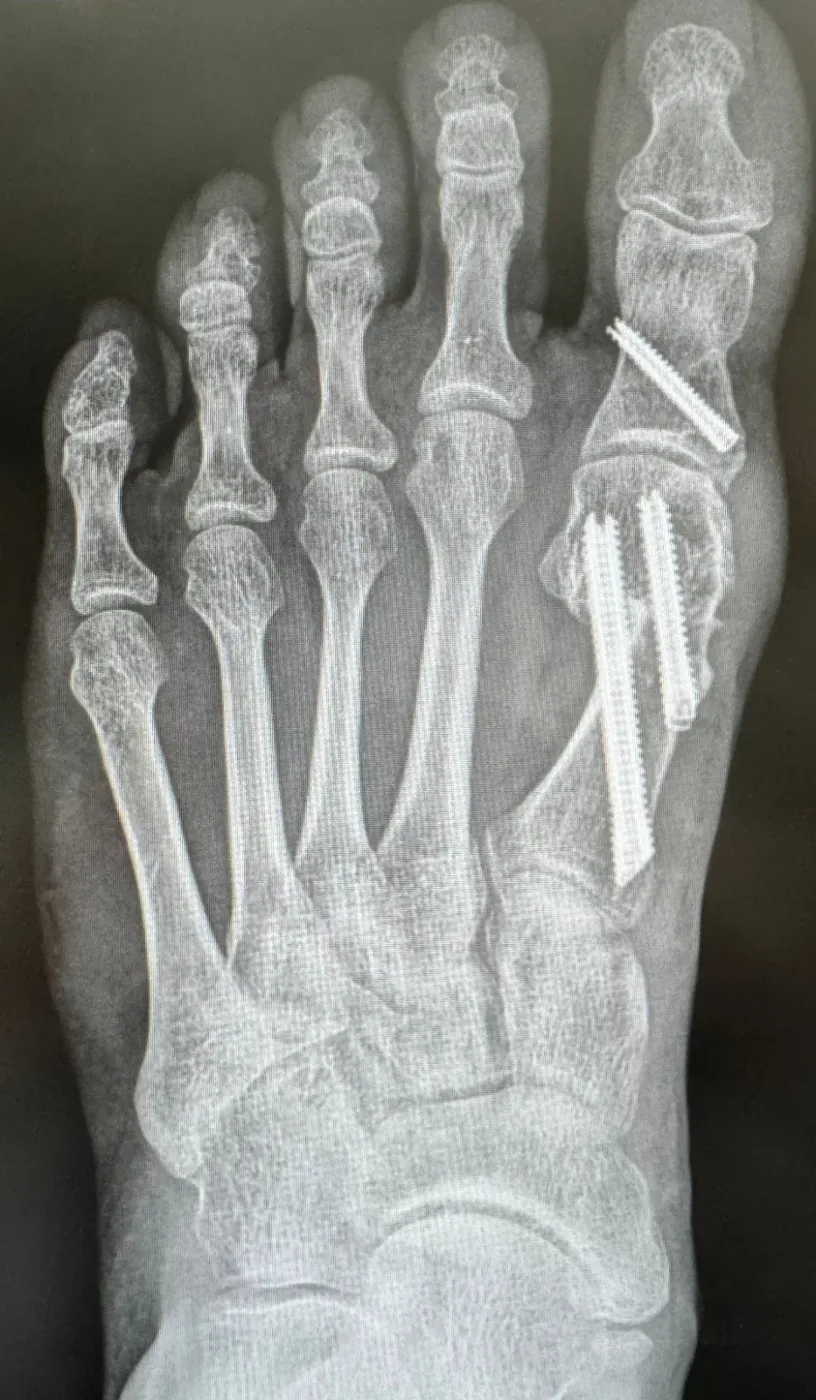
Bunion surgery straightens the big toe by cutting and realigning the first metatarsal (an osteotomy), sometimes with the big toe bone, and fixing it with small screws. It can be done through one incision (open) or several tiny keyhole incisions (minimally invasive). You walk in a surgical shoe from the start, most people are in normal shoes by 6 to 8 weeks, and swelling settles over 3 to 6 months. Most patients have a straighter toe, much less pain and easier shoe wear.
- Anaesthetic
- General or regional anaesthetic
- Hospital stay
- Usually a day case
- Walking afterwards
- Walking straight away in a surgical shoe
- Full recovery
- 3 to 6 months, longer for high-impact sport
Why is surgery sometimes needed?
A bunion (hallux valgus) is a deformity of the big toe joint: the big toe drifts towards the smaller toes and a bony bump develops on the inside of the foot. It can cause pain, difficulty walking, trouble fitting shoes and irritation of the joint. When wider shoes, insoles, pain relief and activity changes no longer help, surgery may be advised to realign the bones and relieve pain.
What does the operation involve?
The most common method is an osteotomy: the surgeon cuts and realigns the bone, usually the first metatarsal and sometimes the big toe bone, then holds it in its new position with screws or similar fixation.
- Open osteotomy (for example, Scarf osteotomy): one incision gives direct access to the bones. Widely used, especially for moderate or complex deformities.
- Minimally invasive (keyhole) osteotomy: several very small incisions, specialised instruments and X-ray guidance. Potential benefits include smaller scars, less soft tissue disruption and less early pain.
- Fusion of the big toe joint, or the joint further back in the foot, is used for arthritic, severe or recurrent bunions. See big toe fusion.
Recovery: what to expect
0 to 2 weeks
- The foot is bandaged and you can walk in a surgical shoe; crutches can help at first
- Rest and keep the foot raised as much as possible
- Swelling is normal and can last for months
2 to 6 weeks
- Bandages and stitches are removed at your first wound check
- Gentle toe movement exercises begin
- You keep wearing protective footwear; a silicone toe spacer may be made for you
6 to 12 weeks
- The bone has usually healed enough for normal (wide) shoes by 6 to 8 weeks
- Low-impact exercise can restart
- You can drive once you can control the car safely in a normal shoe
3 to 6 months and beyond
- Swelling may take 3 to 6 months to settle
- Long walks often become comfortable at 4 to 6 months
- Return to high-impact sport varies from person to person
Recovery varies with the exact procedure and with each person. You will get a plan specific to your operation.
Expected outcomes
Before surgery
- Painful bump at the base of the big toe
- Big toe drifting towards the other toes
- Difficulty walking and finding shoes that fit
- Irritation of the joint
After surgery
- A straighter big toe
- Much less pain
- Better comfort walking, standing and exercising
- Easier fitting of shoes
Most patients stay improved in the long term, and national registry data show improvements well beyond the threshold that patients notice as meaningful. Recurrence is possible but uncommon. The screws are usually left in permanently but can be removed if they cause problems. Good footwear, avoiding narrow pointed shoes, helps keep the result.
Consent information
Read the consent form before your operation so you know what you are agreeing to. Bring any questions to your pre-operative appointment.
- Consent form: hallux valgus (bunion) correction (Word document)
- Consent form: hallux valgus and lesser toe correction (Word document)
Common questions
Open or keyhole surgery: which is better for me?
Both realign the bone. Keyhole (minimally invasive) surgery uses several small incisions and X-ray guidance, and may mean smaller scars, less soft tissue disruption and less early pain. Open surgery through one incision is widely used, especially for moderate or complex deformities. Which suits you depends on your foot shape, bone quality and the deformity, and Prof Mason will recommend the best option.
Will the screws need to come out?
Usually not. They are designed to stay in permanently, but can be removed with a small operation if they become prominent or uncomfortable.
Considering this operation?
Talk it through with Prof Mason. New consultation £250.

Consultant Foot and Ankle Surgeon, MB BCh, PhD, FRCS (Tr&Orth), FRCS (Glasg), SFHEA, FFSTEd. GMC 6074953.
Prof Mason's published research on this topic
Peer-reviewed papers by Prof Mason and his colleagues. Links open the paper or its PubMed record.
- Lewis T, Malhotra K, Makwana N, Wood E, Humphrey J, Mason L. Lifetime cost-effectiveness of hallux valgus correction surgery using patient-reported outcomes from the National British Orthopaedic Foot and Ankle Registry in the United Kingdom. The Foot, 2026.
- Marusza CJ, Stringer H, Redfern J, Sangoi D, Welck M, Mason LW, Malhotra K. The position, orientation and morphology of the peroneus longus tubercle in hallux valgus: a weight-bearing CT assessment. The Foot, 2025.
- Weigelt L, Heyes G, Mason L, Molloy A. The Scarf osteotomy. Techniques in Foot & Ankle Surgery, 2021.
- Heyes G, Vosoughi AR, Weigelt L, Mason LW, Molloy AP. Pes planus deformity and its association with hallux valgus recurrence following Scarf osteotomy. Foot & Ankle International, 2020.
- Swanton E, Mason LW, Molloy A. How do I use the Scarf osteotomy to rotate the metatarsal and correct the deformity in three dimensions?. Foot and Ankle Clinics, 2018.
- Nebhani N, Trivedy M, Heyes G, Molloy A, Mason L. Hallux valgus interphalangeus measurement: comparison of two radiographic methods. Foot & Ankle Specialist, 2024.
- Mason LW, Tanaka H. The tarsometatarsal joint and its association with hallux valgus. Bone & Joint Research, 2012.
- Perera A, Mason LW, Stephens MM. The pathogenesis of hallux valgus. Journal of Bone and Joint Surgery (American), 2011.