In short
Rheumatoid forefoot surgery treats pain, deformity and joint damage in the front of the foot caused by rheumatoid arthritis, such as bunions, dislocated or overlapping toes and painful calluses. It is tailored to each foot and may combine fusion of the big toe joint with lesser toe procedures and soft-tissue balancing. You walk on your heel in post-operative footwear or a cast at first, an X-ray at 6 to 12 weeks checks the fusion, and most patients have much less pain and wear normal shoes more comfortably.
- Anaesthetic
- General or regional anaesthetic
- Hospital stay
- Usually a day case or short stay
- Walking afterwards
- Heel or protected weight-bearing in post-operative footwear or a cast
- Full recovery
- 3 to 6 months and beyond
Why is surgery sometimes needed?
Rheumatoid forefoot surgery is used to treat pain, deformity and joint damage in the front of the foot caused by rheumatoid arthritis. The condition can lead to toe deformities, bunions, dislocated toes and painful calluses that interfere with walking and footwear. Surgery realigns the forefoot, corrects deformity and redistributes pressure to improve comfort and function.
What does the operation involve?
The procedure is tailored to the pattern of deformity and may include:
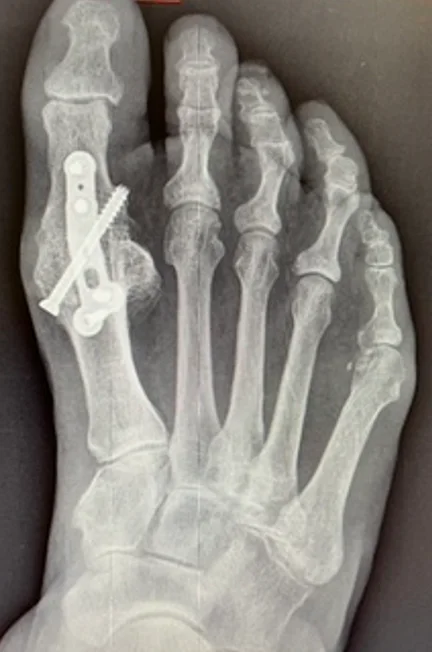
- Big toe correction, such as fusion of the 1st MTP joint for alignment and power
- Lesser toe procedures, including shortening osteotomies or MTP resection arthroplasties
- Soft-tissue balancing to reduce deforming forces
- Callus removal at high-pressure areas
- Correction of dislocated toes where required
The surgery is typically performed under general or regional anaesthetic with postoperative support in specialist footwear.
Recovery: what to expect
0 to 2 weeks
- Protected in post-operative footwear or a cast
- Heel or protected weight-bearing as advised
- Elevation helps reduce swelling
- Stitches removed around 10 to 14 days
2 to 6 weeks
- Continued healing with gradual improvements in comfort
- Transition towards more normal footwear depending on swelling and dressing requirements
- Toe alignment maintained with splints or dressings
6 to 12 weeks
- An X-ray will be performed to check on fusion progress
- Return to supportive footwear
- Walking distance increases
- Physiotherapy may assist with balance and gait retraining
3 to 6 months and beyond
- Continued reduction in swelling and callus burden
- Comfort in daily footwear improves significantly
- Most patients regain improved mobility and reduced pain
- Some swelling may persist, especially after prolonged standing or activity
Recovery varies with the exact procedure and with each person. You will get a plan specific to your operation.
Expected outcomes
Before surgery
- Painful bunion or toe deformities
- Calluses and footwear difficulty
- Dislocated or overlapping toes
- Reduced walking tolerance
After surgery
- Improved alignment and stability
- Major reduction in pain and pressure
- Better tolerance of normal shoes
- Improved confidence and mobility
Most patients maintain good alignment and pain relief long-term. The procedure supports independence and quality of life. Continued rheumatology input optimises overall outcomes.
Rheumatoid forefoot surgery is an effective treatment for deformity and pain affecting the toes and forefoot in rheumatoid arthritis. By correcting alignment, removing pressure points and restoring balance across the foot, the procedure improves footwear comfort, mobility and overall quality of life.
Consent information
Read the consent form before your operation so you know what you are agreeing to. Bring any questions to your pre-operative appointment.
- Consent form: rheumatoid forefoot arthroplasty (Word document)
Having surgery? Please join the national foot and ankle registry.
Considering this operation?
Talk it through with Prof Mason. New consultation £250.

Consultant Foot and Ankle Surgeon, MB BCh, PhD, FRCS (Tr&Orth), FRCS (Glasg), SFHEA, FFSTEd. GMC 6074953.
Prof Mason's published research on this topic
Peer-reviewed papers by Prof Mason and his colleagues. Links open the paper or its PubMed record.
- Jadhakhan F, Makwana N, Mason L, Halliwell P, Rushton A. Clinical outcomes of first metatarsophalangeal joint arthrodesis using the BOFAS Registry: a prospective cohort study. Journal of Foot and Ankle Research, 2025.
- Weigelt L, Redfern J, Heyes G, Butcher C, Molloy A, Mason L. Risk factors for non-union after first metatarsophalangeal joint arthrodesis with a dorsal locking plate and compression screw construct: correction of hallux valgus is key. Journal of Foot and Ankle Surgery, 2021.
- Chapman J, Dalal N, Molloy A, Jenkinson H, Singh A, Sirikonda S, Mason L. Association of fusion of the first metatarsophalangeal joint and pes planus deformity correction. Foot & Ankle International, 2023.